
 Rapids Tribune, October 21, 1995 - by LISA FOSTER
LHS teacher and 17 researchers will study seismics and geology in Antarctic waters
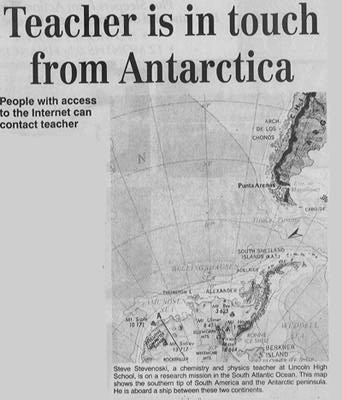
Steve Stevensoski, chemistry and physics teacher at Lincoln High School, will leave today for Antarctica.
He is one of four teachers selected nationally to participate as a researcher there. He was chosen by the National Science Foundation from a pool of 50,000 science teachers to accompany and assist Lawrence Lawver at the University of Texas Institute for Geophysics and Gary Klinkhammer, Oregon State University, in their research aboard the Ice Breaker RV Nathaniel Palmer.
He was nominated for this project by the Wisconsin Academy of Science, Arts and Letters. He found out that he would be going on this adventure in April.
Stevenoski will depart today from Mosinee, where he will fly to Miami, to Santiago, Chile and then to another Chilean city where he will board the ship for a three day cruise to the Antarctic peninsula. During his journey, he will travel through the Drake Passage. "It's one of the roughest rides in the world," Stevenoski said. He anticipates waves up to 40 feet and wind gusts between 70 and 80 mph.
One on board the 280 foot ice breaker, he will join 17 other researchers, five technical supporters and the ship's crew. This will be his home during the six week research project. He anticipates temperatures to range anywhere from the high 30's to below zero.
The project that Stevenoski and the others will be working on will involve the seismic and geological study of the region of ocean alon Antarctica called the Bransfield Strait. The research will focus on identifying deep ocean volcanic features, specifically oceanic microplates and geothermal vents.This research could potentially lead to the discovery of the southern most geothermal formations in the world. Their discovery could provide new evidence for understanding volcanoes, earthquakes and the origins of life.
Stevenoski will be able to stay in contact with students at LHS and throughout the state and nation via an Internet Web Page called the "Antarctic Link" project. The web page is a file on the Internet which can be accessed by anyone who has a computer connection to the Internet.The web page will have daily journal entries and updates on the researchers and their activities. The web page will also give students and teachers who access the web page the opportunity to send questions directly to Stevenoski and other researchers through Internet email.
"I'll be in touch daily with my students," Stevenoski said. The web page was developed with technical support from the USCyber Co. and individual efforts of many teachers in science, math, and art at LHS. More than 60 schools statewide are prepared to have their students involved with the project. Similar projects have been funded by major contributions, but they lacked the ability for individuals to contact individuals in Antarctica directly with their questions. This project will be a first for directly linking teachers, students and researchers on a daily basis in Antarctica. This project is an even greater challenge because the researchers are on a moving ship which makes satellite communication even more difficult.
Stevenoski will return to Wisconsin Rapids the week of Dec. 11.